
Physical Intervention in Schools: What Staff Need to Know in 2026
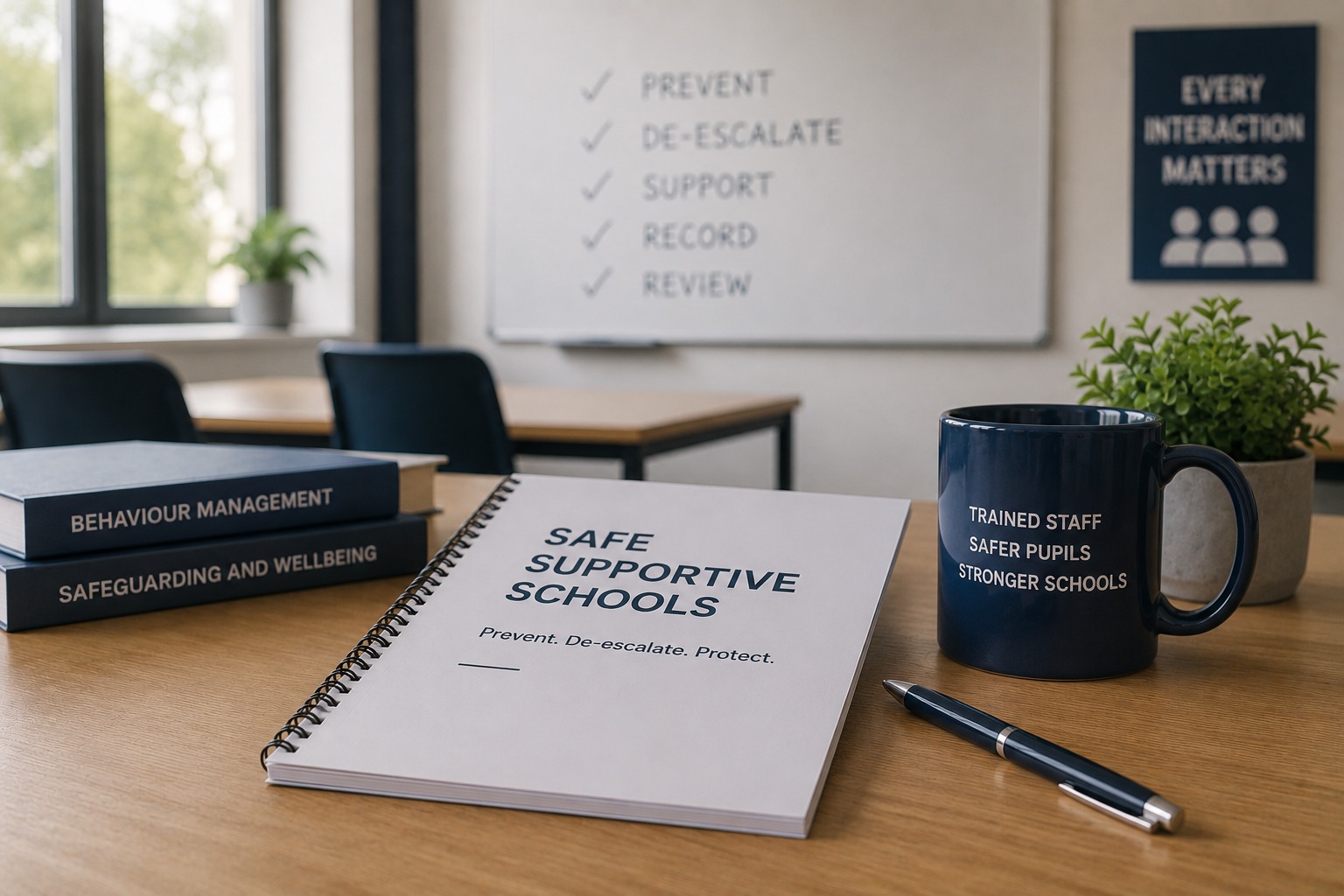
Physical intervention in schools is a safeguarding measure—not a shortcut for managing difficult behaviour. There may be situations in which staff need to act physically to protect a pupil, another person, or the wider school community. However, any intervention must be lawful, necessary, proportionate, and used for the shortest possible time. Schools should place prevention, positive relationships, de-escalation, and individual support at the centre of their approach. This is particularly important in 2026. New Department for Education guidance on restrictive interventions came into force in England on 1 April 2026, introducing clearer expectations around prevention, recording, reporting, and staff training. Schools in Wales continue to work under Welsh Government guidance, including the Safe and Effective Intervention guidance and the Reducing Restrictive Practices Framework. At SLC Training, we help education professionals understand their responsibilities and develop the practical skills needed to prevent incidents and respond safely when physical intervention becomes unavoidable. Please note: This article provides general information and should not be treated as legal advice. Schools should follow the legislation, national guidance, local authority procedures, and professional advice applicable to their setting. Physical intervention is a broad term. It can describe anything from guiding a pupil away from danger to restricting their movement during a serious incident. Not every form of physical contact is a restrictive intervention. Appropriate contact may include: Schools should not adopt blanket “no contact” policies. Such policies may prevent staff from providing appropriate support or acting quickly to protect a child from harm. Staff must instead use professional judgement, taking account of the pupil’s age, needs, vulnerabilities, and the circumstances of the incident. The terminology becomes more specific when physical contact or another action restricts a pupil’s movement. The terminology used by schools, local authorities, and training providers may vary. The most important questions are what staff did, why they did it, what risks were present, and whether the response was necessary and proportionate. In England, members of school staff have a legal power to use reasonable force in certain circumstances. It may be used to prevent or stop a pupil from: Welsh guidance similarly states that school staff may use reasonable force to prevent an offence, injury, property damage, or behaviour that seriously prejudices good order and discipline. These powers do not mean that physical intervention is automatically appropriate whenever one of these situations arises. Staff must assess the circumstances in front of them. A response that may be reasonable during an immediate risk of serious injury could be wholly disproportionate in response to low-level disruption or refusal to follow an instruction. Before and during a restrictive intervention, staff should continually assess whether their actions remain justified. Key questions include: The assessment must continue throughout the incident. An intervention that appeared appropriate initially may need to be reduced or stopped if the circumstances change. Force must not be used to punish a pupil, demonstrate authority, secure compliance for convenience, or retaliate against challenging behaviour. In England, using force as punishment is illegal. Current guidance also warns against restraint that affects a pupil’s airway, breathing, or circulation, including pressure around the neck or abdomen. The Welsh Reducing Restrictive Practices Framework also states that restrictive practices must never be punitive or used to compensate for staff shortages, inadequate planning, or other resource pressures. A pupil’s behaviour may require a disciplinary response after an incident. That process must remain separate from any immediate physical action taken to maintain safety. Good physical intervention practice begins long before physical contact takes place. Schools should examine why incidents are occurring and whether changes to the environment, timetable, communication, or support could reduce the risk. Prevention should be embedded across the whole school rather than left solely to staff who respond to emergencies. Effective preventative and de-escalation measures may include: De-escalation does not mean staff must continue talking indefinitely while an immediate danger develops. It means using the least restrictive effective response and recognising when an approach is reducing risk—or making the situation worse. Pupils with special educational needs and disabilities—or additional learning needs in Wales—may experience the school environment differently from their peers. Communication difficulties, sensory overload, anxiety, changes to routine, unmet needs, and previous trauma may all contribute to distress. Behaviour that appears deliberately confrontational may sometimes indicate that a pupil is overwhelmed, frightened, in pain, or unable to communicate what they need. Schools must also consider their obligations under the Equality Act 2010, including the duty to make reasonable adjustments for disabled pupils. Where there is a foreseeable risk of serious incidents, schools should work with the pupil, parents or carers, and relevant professionals to develop an individual support plan. This may include: An individual plan does not automatically authorise physical intervention. Staff must still decide whether an intervention is necessary and proportionate in the specific circumstances. The legal power to use reasonable force arises from legislation and the person’s role. It is not created by a training certificate. However, staff who are likely to encounter situations involving physical intervention should receive appropriate training. Training decisions should reflect the school’s pupils, environment, incident history, and level of foreseeable risk. High-quality physical intervention training should cover much more than physical techniques. It should include: Training must be relevant to the environment in which staff work. The needs of a mainstream primary school, specialist provision, pupil referral unit, and further education setting are unlikely to be identical. The Department for Education’s guidance, Restrictive Interventions, Including Use of Reasonable Force, in Schools, took effect on 1 April 2026 and replaced the previous reasonable-force guidance. One of the most significant changes concerns recording and reporting. Governing bodies and proprietors must ensure that procedures are in place to record every significant incident in which a member of staff uses force on a pupil. Records must be made in writing as soon as practicable, with staff expected to aim for completion on the same day. The record should include: Schools must also have procedures for informing parents about significant uses of force as soon as practicable, normally aiming to do so on the same day. Information should generally be provided in writing. Limited safeguarding exceptions may apply where informing a particular parent could place the pupil at risk of serious harm. Schools in Wales should continue to follow the Welsh Government’s Safe and Effective Intervention guidance, the Reducing Restrictive Practices Framework, and relevant local authority procedures. Welsh guidance strongly advises schools to keep systematic records of every significant incident involving force. The wider restrictive-practices framework expects any use of a restrictive practice to be recorded, including where it was anticipated within an individual support plan. Records should include information such as: Schools should avoid copying an English policy without adapting it. The legal foundations overlap, but current national guidance and reporting expectations are not identical. The end of the immediate risk is not the end of the school’s responsibility. Following a physical intervention, the school should: Post-incident support should be separated from reflective learning. Pupils and staff may need time to regulate before they are ready to discuss the incident constructively. Reviews should focus on learning and prevention rather than blame. Every school should have an accessible policy that staff can understand and apply under pressure. The policy should clearly address: The policy should be consistent with the school’s behaviour, safeguarding, health and safety, equality, and complaints procedures. It should also be communicated to staff, pupils, and parents in an accessible form. Treating physical intervention as a behaviour-management technique Restrictive intervention is a risk-management response. It should not become a routine consequence for refusal, verbal defiance, or low-level disruption. Focusing training only on restraint techniques Technique-led training without prevention, de-escalation, legal knowledge, and post-incident learning can create additional risk. Using a generic policy copied from another setting A policy should reflect the school’s pupils, environment, staffing, incident history, and national jurisdiction. Assuming parental agreement makes an intervention lawful Parents should be involved in planning, but an agreed plan does not remove the requirement to assess necessity and proportionality during each incident. Recording only incidents that result in injury The significance of an incident is not determined solely by whether someone was visibly injured. Restriction, distress, duration, risk, and the type of intervention must also be considered. Failing to review patterns Repeated interventions involving the same pupil, group, staff team, or location may indicate unmet needs, environmental problems, inadequate planning, or inconsistent practice. Can a teacher physically remove a pupil from a classroom? Potentially, but not simply because physical removal is convenient. Staff must consider the legal basis, the seriousness of the behaviour, the available alternatives, and whether the action is necessary and proportionate. Can an untrained member of staff intervene in an emergency? Training does not create the statutory power to use reasonable force. A member of staff may need to act during an unforeseen emergency. However, staff who are reasonably likely to face these situations should receive suitable training, and schools should not rely on untrained emergency responses as their normal approach. Must parents consent before reasonable force is used? The statutory power is not dependent on advance parental consent. Parents should nevertheless be involved in individual planning where possible and informed after incidents in accordance with the relevant requirements. Is every physical interaction a restraint? No. First aid, appropriate guidance, comfort, and teaching-related contact are not automatically restrictive. The context, purpose, and effect of the contact must be considered. Is a calming or sensory room a form of seclusion? Not where the pupil enters voluntarily and remains free to leave. It may become seclusion where a pupil is confined and prevented from leaving through a physical barrier, blocking, or threat of punishment. The purpose of physical intervention training should not be to make restraint easier or more frequent. It should help schools prevent crises, recognise risk earlier, and ensure staff respond lawfully and safely when less restrictive options cannot manage an immediate danger. A strong whole-school approach combines: At SLC Training, we provide physical intervention, conflict management, and safeguarding training for education settings. Our programmes can be tailored to the risks, policies, and pupil needs within each organisation, with physical intervention modules supported by risk-assessment assistance and qualification options. Contact SLC Training to discuss a physical intervention programme designed around your school and the needs of the pupils and staff you support.Physical Intervention in Schools: What Staff Need to Know in 2026
What Is Physical Intervention in a School?
Understanding Restrictive Intervention, Restraint, and Seclusion
When Can School Staff Use Reasonable Force?
The Central Tests: Necessity and Proportionality
Physical Intervention Must Never Be Used as Punishment
Prevention and De-escalation Must Come First
SEND, ALN, Disability, and Trauma
Do School Staff Need Physical Intervention Training?
What Changed in England in April 2026?
What Is Expected in Wales?
What Should Happen After an Incident?
A Physical Intervention Policy Checklist for School Leaders
Common Mistakes Schools Should Avoid
Frequently Asked Questions
Conclusion: Creating Safer and More Confident School Teams